
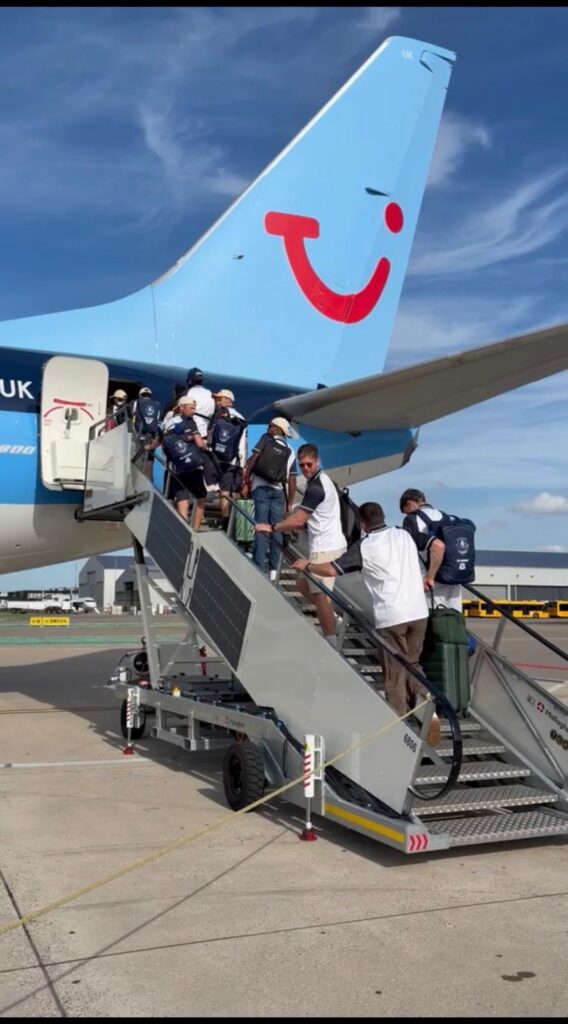
September brought two international cricket operations into focus for Coraaj. The inaugural European T20 Premier League was being staged across the Netherlands and Ireland, while the Caribbean Premier League and Women’s Caribbean Premier League were running concurrently in the Caribbean.
The demands extended well beyond getting players and staff from one destination to another. Multiple movements had to be coordinated across different jurisdictions, with visa requirements, travel documentation, flight changes, baggage and equipment all capable of altering an itinerary at short notice.
At the ETPL, Coraaj supported three of the six participating franchises, Dublin Guardians, Rotterdam Dockers and Belfast Wolves, with players and staff travelling from around the world for matches in Voorburg and Malahide.
Two particular challenges illustrated the complexity of the operation: securing visas for players who could not use the usual application route, and recovering almost 100 bags after a charter flight was unable to accommodate the full baggage load.
When players could not use the usual visa route
Several players travelling to the ETPL required Schengen visas, but some of them could not use the standard UK visitor route to submit their applications. With fixed match dates and players already committed to their respective teams, the timing left little room for delay.
Coraaj worked through the circumstances of each player to establish an alternative route through which the applications could be progressed in time.
For key players, including Henrich Klaasen, special appointments were secured with the relevant embassy. The circumstances surrounding the tournament and the need for the players to travel had to be explained, with the applications subsequently progressed outside the usual route. The necessary paperwork was secured and the players were able to travel to Europe taking full part in the tournament without any delays.
The episode illustrates the wider complexity of travel documentation in international sport. Establishing whether a player requires a visa is only the starting point. The application route, country of application, nationality, transit points and timing all have to align. A confirmed flight does not, in itself, guarantee that a player can travel if the necessary documentation is not in place.
99 bags left behind in Rotterdam
The second major ETPL challenge followed a charter flight from Rotterdam to Dublin that was unable to accommodate the full baggage load. Of 323 bags, 99 remained behind.
For a cricket franchise, the implications were immediate. The missing luggage included cricket equipment and playing kit required by the teams for the tournament, rather than simply personal belongings and a swift alternative arrangement was needed.
The 99 bags were transferred from Rotterdam to Amsterdam, where they could be allocated to other services travelling to Dublin. In total, they were distributed across five separate flights.
A further discrepancy involving 25 bags emerged once the baggage began arriving in Dublin, requiring coordination with the airport team on the ground to identify and recover the remaining luggage. The full operation was completed within three days, with all of the bags ultimately delivered.
The recovery involved a series of interdependent movements. Bags had to be located and transferred between airports, allocated across different services and tracked through to Dublin, while the teams continued to operate to the tournament schedule.
A new tournament without an established support structure
Both incidents were further complicated by the fact that the ETPL was entering its inaugural season. There was no established operational history for the tournament’s international travel requirements, nor an established visa support structure for players travelling from different countries.
The work therefore involved responding to the specific circumstances as they arose, from individual visa applications and embassy appointments to alternative baggage routings and coordination with airports and airlines as the tournament moved between the Netherlands and Ireland. It is a useful distinction between arranging travel and managing sports travel. The itinerary may be fixed, but the operational picture rarely is.
And the same principle applies beyond Europe.
From the ETPL to the Caribbean
While the ETPL was under way, Coraaj was simultaneously supporting travel operations across the Caribbean Premier League and Women’s Caribbean Premier League.
For the Barbados Royals and production crews working across the CPL and WCPL, the operational challenges can be quite different. Flight cancellations, limited connectivity between destinations, baggage delays and visa restrictions can all have an immediate impact on the schedule.
When a flight is cancelled, the priority becomes identifying the next viable service. If that flight is already full, alternative routings may need to be considered. Equipment introduces another layer of complexity. Large and valuable production equipment needs to move safely between destinations, sometimes requiring charter options or careful allocation between crew members with the appropriate visas to carry it into the destination country.
The circumstances may differ, but the underlying requirement remains the same: understand the restrictions, identify the available options and keep the operation moving.
The work behind the journey
September brought together many of the issues that sit behind international sports travel: visa applications that cannot follow the standard route, documentation that has to be in place before a player can fly, baggage that has to be recovered across multiple airports, and journeys that have to be reconstructed when circumstances change.
For the players and teams, the objective remains straightforward. Arrive on time, with the correct documentation and the equipment required to focus on playing cricket at the highest level.
Behind that simplicity sits a considerably more intricate operation, one in which plans can change quickly and solutions often have to be found in real time.
Across the ETPL, CPL and WCPL, September provided a clear illustration of the logistical work required to keep international cricket moving smoothly.